This content has been automatically translated from Ukrainian.
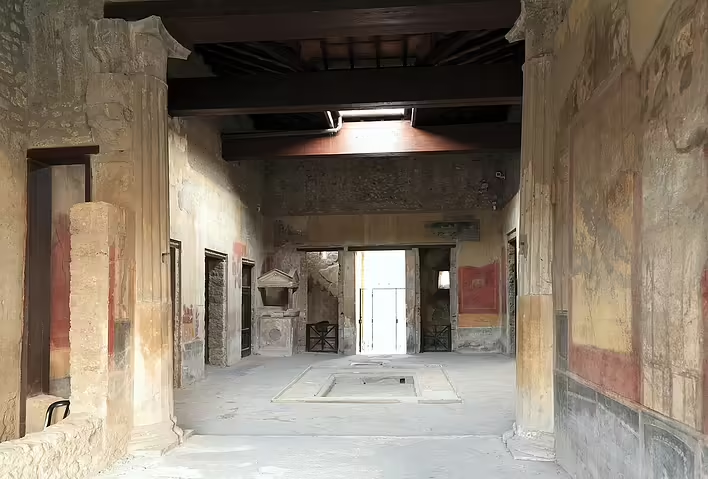
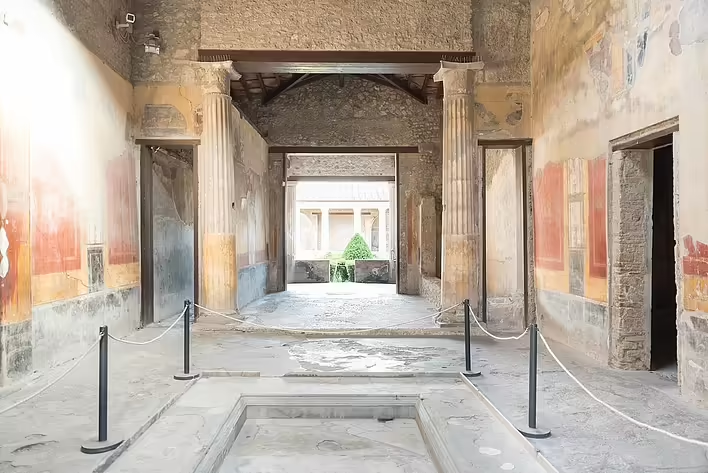
Cavaedium or atrium — is the Latin name for the main room of a Roman house, which usually had a central opening in the roof (compluvium) and a pool for rainwater (impluvium) beneath it.
The cavaedium passively collected, filtered, stored, and cooled rainwater. It also served the function of daylighting, passive cooling, and passive ventilation for the house.
Functions
The atrium was the most important room in a Roman house. The main entrance led to it; marriages, funerals, and other ceremonies were held there. In earlier and more modest houses, the atrium served as a common room used for most household activities; in wealthier houses, it became primarily a reception room, while private life moved deeper into the (larger) house. The atrium was typically the most refined room with the best finishes, wall paintings, and furniture.
The atrium was accessed either through a shop or a direct narrow passage from the street.
The less open room behind the atrium was the tablinium (a room in a Roman residence), usually the study of the master of the house.
Behind it was a garden; the temperature difference between the atrium and the garden created a draft through the tablinium, making it the coolest room in the house.
If the curtains or movable partitions of the tablinium were not closed, a visitor in the passage could see through the atrium and tablinium to the garden; care was taken to make this view impressive.
Ideally, the rooms beyond the atrium were arranged symmetrically or at least in a way that gave an impression of symmetry. Bedrooms (cubiculum) and alleys (“wings” of the atrium, niches separated by a partition but not a wall) typically opened from the sides of the atrium.
Where was the atrium used?
Small rural Roman buildings did not require atriums; they were lit by windows and drew water from wells or streams. On the other hand, urban houses (domus) had to be built on small narrow plots, as urban land was expensive, and the street was even more costly. There were also concerns about theft. In this way, urban houses began to look inward to the cortile, enclosed courtyards, with light and water coming from above.
Sometimes urban houses retained a walled garden behind, which later often became a peristyle (a continuous porch formed by a row of columns surrounding the perimeter of a building or courtyard), a sort of monastery surrounded by rooms.
Large rural estates sometimes built around large enclosed farmyards, but a Roman villa or country residence imitated the urban residence from which the wealthy owner typically came and often had an atrium (or several). Later in Roman history, the atrium was sometimes also replaced by a peristyle and a rainwater collector.
Urban houses of poorer Romans might not have had atriums at all; however, judging by (mostly Pompeian) survey data, atriums, peristyles (or both) were found in almost all Roman houses larger than 350 square meters, most over 170 square meters, and some over 50 square meters.
Daily use
The cavaedium was a public space. Marcus Terentius Varro says it was “left open for general use by all.” Vitruvius describes it as a room into which “anyone from the people has the full right to enter, even without invitation.” In this way, it was a sort of living room.
Spinning and weaving, essential household tasks, were traditionally done in the atrium, as were other domestic activities. Toys, flutes, writing utensils, tableware, and pottery were found in atriums.
Wealthier Romans received visitors in the morning when their clients gathered in the atrium for salutatio (characteristic relationships in Roman society between patronus (“patron”) and their cliens (“client”)). The patron often welcomed them from the tablinium.
The atrium was typically the most elaborate room with the finest artworks, wall paintings, imported marble wall coverings, and marble or mosaic flooring (mosaic, even more expensive than imported marble slabs). The houses of the wealthiest Romans became more ostentatious as growing inequality in wealth intensified inequality in housing, and as the demonstration of virtue became less socially important while extravagance became more important.
This use of the patron class as reception areas made the atrium a semi-public space, and it became known as pars urban, the urban part of the house. The more private space behind the tablinium was pars rusticana, the rural part.
Pars rusticana was centered around the peristyle; it did not exist in early Roman houses. Greek culture held high value in Roman culture. The peristyle was borrowed from Greek architecture and became popular, sometimes replacing the atrium over time.
As a result, the names for pars urban are Latin, while the names for pars rusticana are Greek loanwords. In rural areas, the order was sometimes reversed; pars urbana cortile, which was entered from the main street, was the peristyle. While the atrium was buried deep in the house, often near the portico (an outward-looking colonnade on one or more exterior walls) overlooking the landscape.
Compluvium
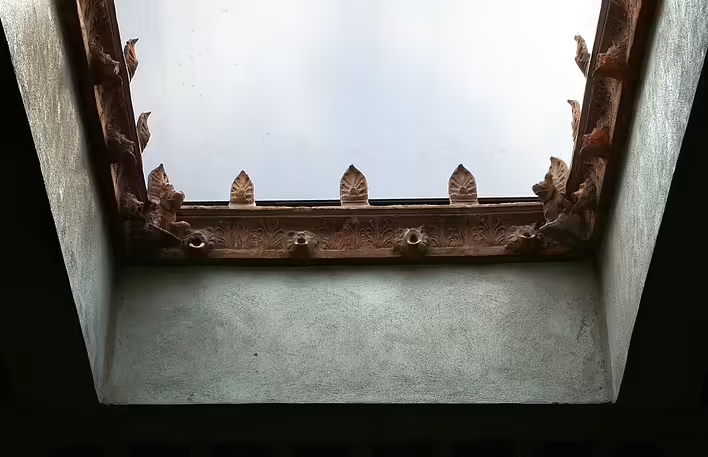
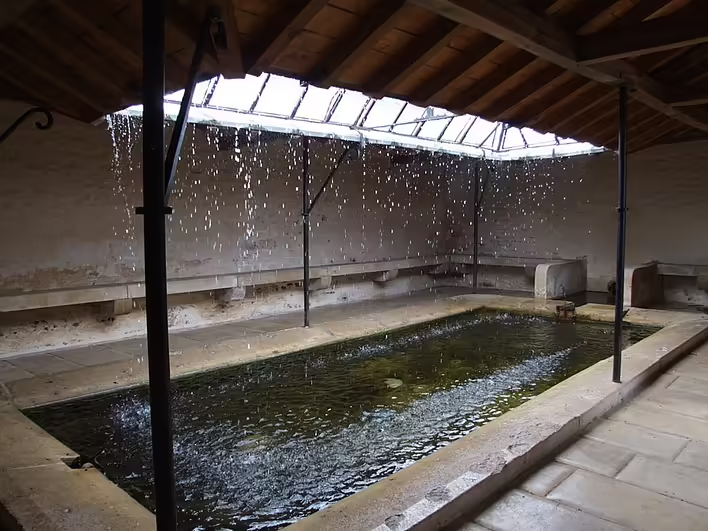
The roof was framed in such a way as to leave an open space in the center, known as the compluvium. Rain from the roof was usually collected in gutters (a component of the building's drainage system) around the compluvium and drained from there into the impluvium (a rainwater collection basin designed to collect rainwater).
The roof around the compluvium was bordered by a row of heavily ornamented tiles, called antefixes (a vertical block that finishes and conceals the tile of a tiled roof), on which a mask or some other figure was sculpted. At the corners, there were usually spouts in the shape of lion or dog heads or any fantastic creatures that might have appealed to the architect. The spouts directed rainwater into the impluvium, rather than allowing it to run down the walls and columns, which could damage them. As it seeped through the bottom of the impluvium, the water was collected in cisterns, from which it was drawn for household needs.
The compluvium opening could be shaded by a colored veil, likely of open, airy weaving.
Tuscan cavaedium
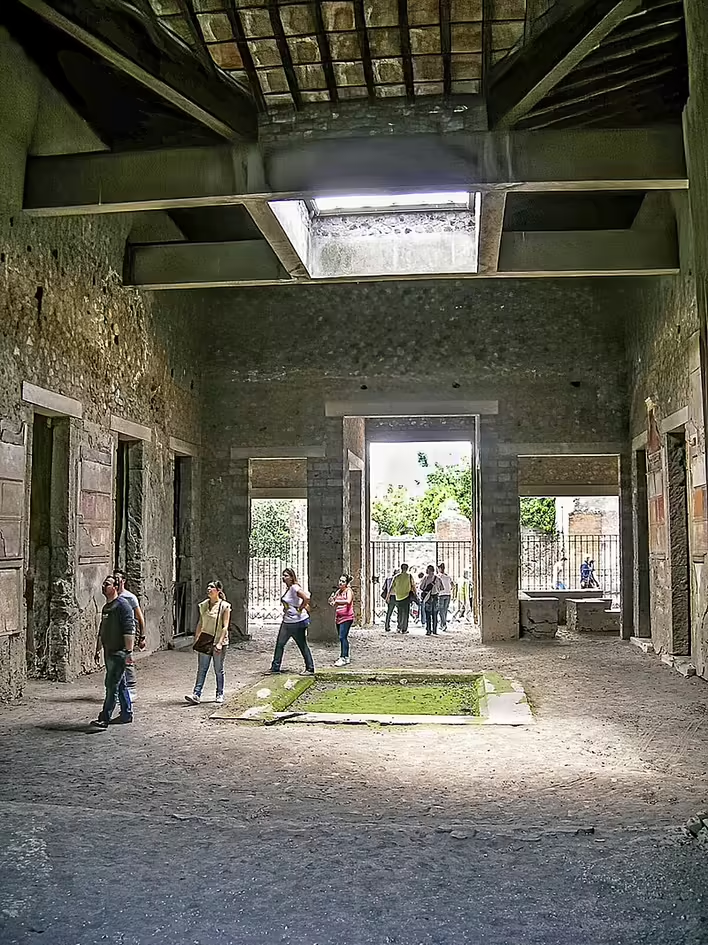
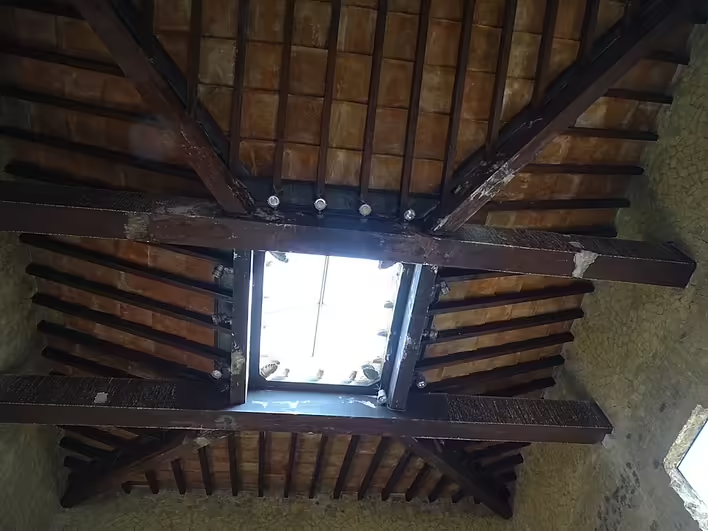
The Tuscan atrium seems to be the most common type in Pompeii. The Tuscan type has the advantage that the walls and columns are very well protected from the elements. For a smaller cavaedium, this is a simple, lightweight structure. However, for a larger cavaedium, very massive wooden beams are required.
For the Tuscan construction, two wooden beams are needed that span the entire atrium and run horizontally from wall to wall. Since the forecourt is usually longer than it is wide (Vitruvius recommends width-to-length ratios of 3:5, 2:3, or 1:√2), the beams typically run across the width of the atrium. The ends of the beams are usually housed (set into a recess in the wall). The beams must be thick enough not to sag excessively under the weight of the roof. As the atrium becomes wider, the span increases until it becomes impractical or impossible to obtain sufficiently large beams. Therefore, the Tuscan style was not used in very large atriums.
Tetrastyle cavaedium
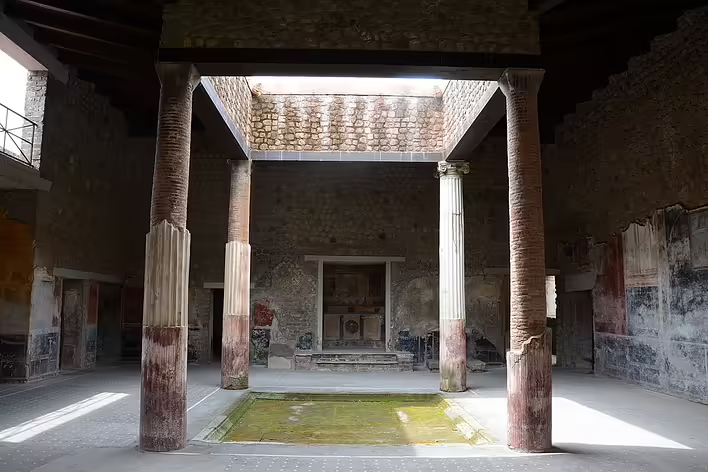
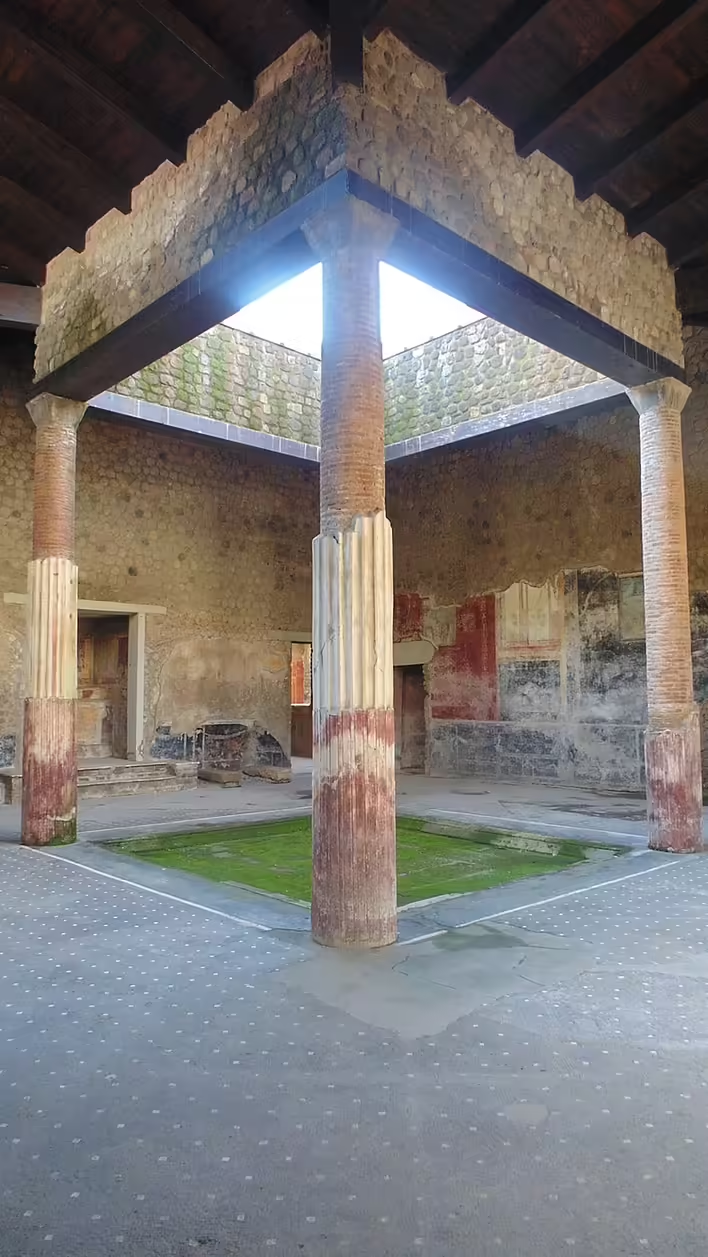
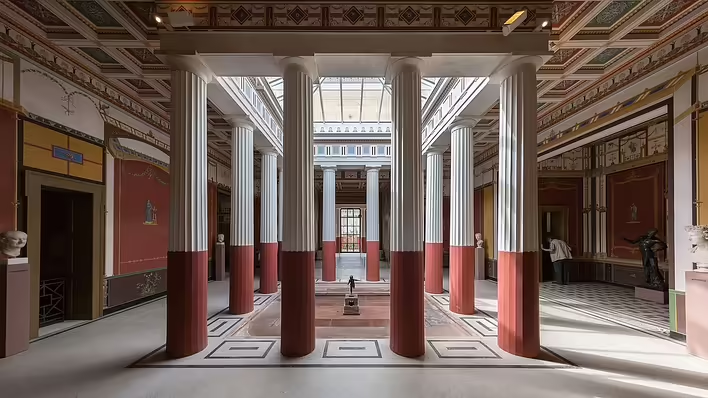
The tetrastyle atrium required additional support due to the size of the hall; this was provided by columns located at the four corners of the impluvium. This style is not common in Pompeii. These columns support a beam that supports a wall, which, in turn, supports the rafters inside the atrium. There is no need for horizontal beams that span the entire room; the rafters have smaller spans. This allows for a larger room to be covered.
Corinthian cavaedium
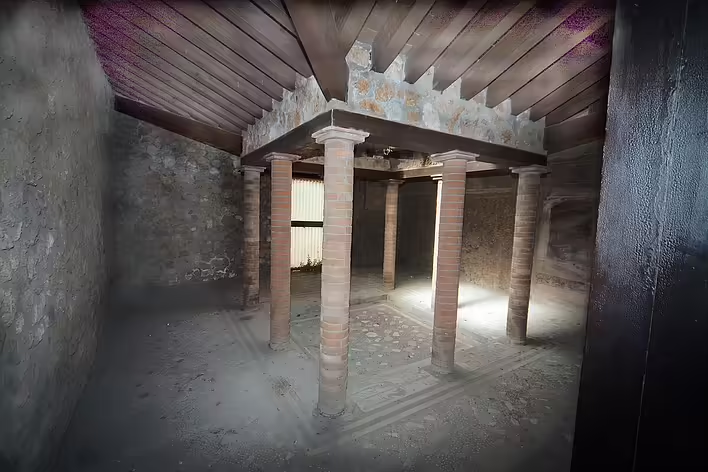
This style has a rectangle of columns around the roof opening. It is like the tetrastyle but with more than four columns. It resembles a peristyle. If the lower layer was strong enough, it could support a second floor.
Displuvial cavaedium
In this style, roofs sloped outward from the compluvium instead of down to it, and gutters were on the outer walls; the roof still had an opening and impluvium to catch falling rain. This type of roof, according to Vitruvius, constantly requires repair, as water does not easily drain due to blockages in the downspouts.
This type was rare; only one was found in Pompeii as of 1911.
Like it?React
🧵
This post doesn't have any additions from the author yet.