This content has been automatically translated from Ukrainian.
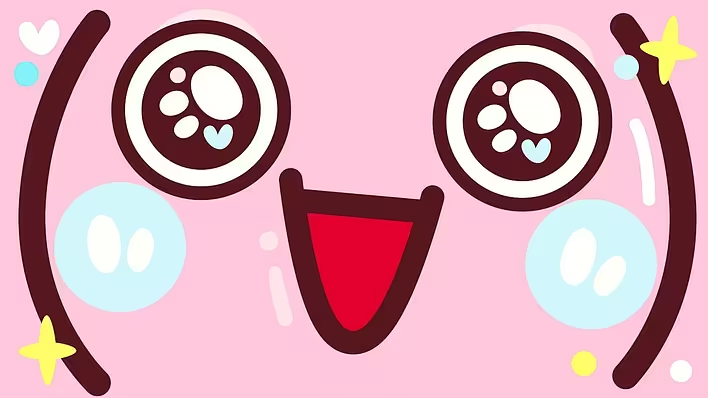
You've probably seen messages like (^_^), (≧▽≦), (T_T), or even the famous ¯\(ツ)/¯. At first glance, it's just a set of characters, but in reality, it's a special way to convey emotions through text. These text "faces" are called kaomojis.
They appeared long before modern emojis, yet they remain popular even today. Kaomojis are used in messengers, social networks, forums, Discord, Twitch, Steam, and of course, in the Japanese segment of the internet. Moreover, Japanese culture has significantly influenced the development of digital ways to express emotions.
What does the word "kaomoji" mean?
The word kaomoji (Japanese: 顔文字, kaomoji) literally means "face made of symbols".
The name consists of two Japanese words:
- 顔 (kao) — face;
- 文字 (moji) — symbols, letters, or signs.
That's why kaomojis are sometimes referred to as Japanese text emoticons.
Unlike familiar emoticons like :-) or :(, Japanese emoticons do not need to be turned sideways. They are read straight, like regular text, allowing for much more complex and expressive emotions.
How did kaomojis come about?
Kaomojis began to gain popularity in Japan in the mid-1980s with the development of personal computers, email, and local computer networks. Users experimented with different symbols, trying to make text communication more emotional.
One of the first widely known kaomojis was (^_^), proposed in 1986 by Japanese designer Yasushi Wakabayashi. After that, this way of writing began to spread rapidly among Japanese online communities. At the same time, it would be incorrect to call Wakabayashi the sole "inventor" of kaomojis — rather, he became one of their first promoters.
By the 1990s, kaomojis were already a familiar part of Japanese forums, chats, and websites, and later became known worldwide with the spread of anime, manga, and Japanese pop culture.
How do kaomojis differ from regular emoticons?
The main difference lies in which part of the face is emphasized.
In Western emoticons, the most important element is the mouth:
- :-) — smile;
- :-( — sadness;
- :-D — laughter.
In kaomojis, the main emotional load is carried by the eyes. This is related to the characteristics of Japanese culture and art, where eyes are traditionally considered the main means of conveying feelings. That's why even a slight change in symbols can completely alter the emotion.
For example:
KaomojiMeaning(^_^) - Smile(^▽^) - Great joy(T_T) - Crying(>_<) - Pain or dissatisfaction(¬‿¬) - Sly smile(≧▽≦) - Excitement(╥﹏╥) - Deep sadness(・_・;) - Awkwardness( ̄ー ̄) - Self-satisfaction(╯°□°)╯︵ ┻━┻ - Strong irritation
Why are kaomojis so diverse?
Unlike classic emoticons, kaomojis can use almost any Unicode symbols: Japanese characters, mathematical symbols, letters from various alphabets, brackets, quotes, and decorative elements.
This allows for the creation of not just faces, but entire scenes.
For example:
¯\_(ツ)_/¯
— "I don't know".
┐( ̄ヘ ̄)┌
— "I don't care".
(づ。◕‿‿◕。)づ
— Hugs.
(ง •̀_•́)ง
— Ready to fight.
ヽ(・∀・)ノ
— Joy.
٩(◕‿◕)۶
— Celebration or triumph.
With the vast number of available symbols, there are tens of thousands of kaomoji variations, and users are constantly inventing new ones.
Kaomojis and emojis — what's the difference?
Despite the similarity in names, they are different things.
Kaomojis are combinations of regular text symbols.
For example:
(^_^)
or
(╯°□°)╯︵ ┻━┻
Emojis are individual graphic Unicode symbols.
For example:
😊 😂 ❤️ 🤔 😎
Historically, it was Japanese digital culture, where kaomojis were already popular, that became one of the sources of inspiration for creating the first emojis in the late 1990s.
Why are kaomojis still popular?
Despite the immense popularity of emojis, kaomojis have not disappeared. On the contrary, they have received a new wave of popularity with the development of social networks and messengers.
They are loved for being:
- very precise in conveying emotions;
- looking more individual;
- independent of the design of a specific operating system;
- displaying similarly on almost any device;
- an important part of anime, manga, and Japanese internet culture.
Kaomojis are especially frequently used by fans of Japanese culture, gamers, streamers, and active users of Discord, Reddit, and Twitch.
Can you create your own kaomoji?
Yes, and this is what makes kaomojis so interesting.
Just changing a few symbols can completely change the mood of the "face".
For example:
- (^_^) — smile;
- (^ω^) — sincere joy;
- (•‿•) — friendliness;
- (≧◡≦) — excitement;
- (╥﹏╥) — tears;
- (ಠ_ಠ) — disapproval;
- (¬_¬) — skepticism.
In fact, the number of possible combinations is almost limitless.
Frequently Asked Questions
Which is correct: kaomoji or kaomodzi?
Both options can be found in the Ukrainian internet. However, kaomoji more accurately conveys the Japanese pronunciation of the word kaomoji, which is why this variant is more often used in articles about Japanese culture.
How do kaomojis differ from ASCII art?
Kaomojis are small text faces or individual emotions. ASCII art is significantly larger: portraits, animals, buildings, or even entire pictures can be created from hundreds of symbols.
Do kaomojis work on phones?
Yes. Since they are regular text, most modern smartphones, tablets, and computers display kaomojis correctly without the need for additional software.
Kaomojis are Japanese text emoticons that appeared back in the 1980s and have become an integral part of internet culture. Unlike familiar emoticons, they are read without turning the head, use a wide range of symbols, and convey emotions primarily through the eyes. Even in the age of emojis, kaomojis have not lost their popularity, as they allow for more lively, emotional, and creative digital communication.
Like it?React
🧵
This post doesn't have any additions from the author yet.