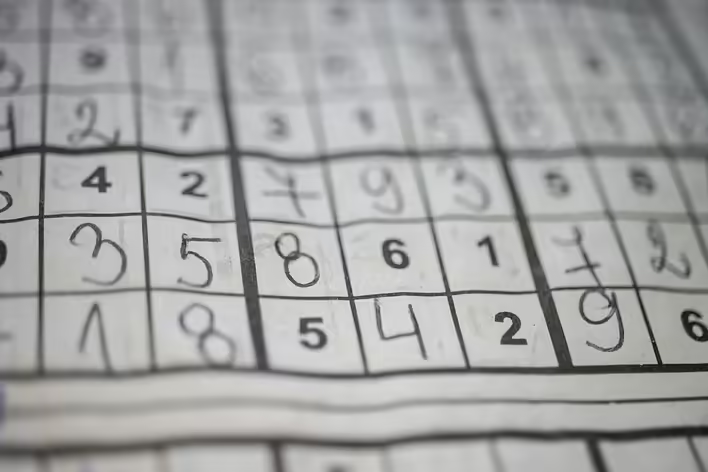
Sudoku is a popular puzzle whose name comes from Japan. The name "sudoku" can be translated from Japanese as "numbers that are themselves" or "isolated numbers".
This puzzle consists of a 9x9 square grid divided into nine 3x3 squares. The goal of sudoku is to fill in each row, each column, and each 3x3 square with numbers from 1 to 9 so that each number appears only once in each row, column, and 3x3 square.
The sudoku puzzle starts with some already filled numbers that serve as starting clues. The level of difficulty can vary depending on the number of already filled numbers and their placement.
Although sudoku and its variations have existed for a long time, it became extremely popular in the early 21st century. Its simplicity, combined with the necessity of logical thinking, makes it interesting and engaging for people of all ages.
When and where did the game Sudoku appear?
The history of sudoku traces its roots back to antiquity, but the modern version of the game, as we know it, was developed in the USA in the 1970s. A game called "Number Place" first appeared in an American puzzle magazine called "Dell Pencil Puzzles and Word Games". This game had the same basic rules as modern sudoku.
But it was Japan that made this game popular. The puzzle was first introduced by the Japanese company Nikoli under the name "Sudoku", which translates to "the same numbers must be unique". This happened in 1984, and since then sudoku has become extremely popular in Japan.
Sudoku gained worldwide popularity in 2005 when the puzzle was included in the crosswords of British newspapers, including The Times and The Daily Mail. Since then, sudoku has become a favorite game for brain training around the world.
Who exactly invented the game Sudoku?
Sudoku, in its modern form, was first developed by American architect Howard Garns and published in the magazine "Dell Pencil Puzzles and Word Games" in 1979 under the name "Number Place". Garns is considered the "father" of sudoku (the company Nikoli gave it the name Sudoku), although the idea of the game, based on Latin squares, has existed for centuries.
What are the rules of the game Sudoku?
Sudoku is a puzzle game that involves filling a grid with numbers according to certain rules. The standard sudoku grid is 9x9 cells, divided into nine 3x3 squares.
The basic rules of the game of sudoku:
Each row must contain all numbers from 1 to 9, with each number appearing only once.
Each column must contain all numbers from 1 to 9, with each number appearing only once.
Each of the nine 3x3 squares that the grid is divided into must also contain all numbers from 1 to 9, with each number appearing only once.
At the beginning of the game, some numbers are already placed on the grid. These numbers cannot be changed.
Sudoku does not require the player to have knowledge of mathematics; all puzzles are based on logic and understanding that each number can appear only once in each row, column, and 3x3 square. There are many variations of sudoku that include additional rules or use different grid sizes.