This content has been automatically translated from Ukrainian.
What does chūnibyō mean
Chūnibyō (Japanese: 中二病, chūnibyō) is a Japanese slang term that ironically refers to excessive adolescent self-consciousness and the associated behavior: demonstrative maturity, a desire to emphasize one's own uniqueness, grandiose fantasies, or a deliberate opposition to others.
In the Japanese dictionary Digital Daijisen, chūnibyō is described as a slang term for excessive self-consciousness characteristic of adolescence and the behavior that arises from it. Examples include unnaturally adult manners and unfounded beliefs in one's own uniqueness.
The word itself consists of two parts:
中二 (chūni) — an abbreviation for the second year of Japanese middle school;
病 (byō) — "disease".
So literally, 中二病 can be translated as "the disease of a second-year middle school student" — approximately a thirteen to fourteen-year-old teenager.
Of course, it doesn't refer to an actual disease. Chūnibyō is not a medical or psychological diagnosis. The word "disease" here was originally part of a joke: certain awkward adolescent behaviors were imagined as a temporary state that one could "catch" and eventually outgrow.
Where the term chūnibyō came from
Unlike many slang words, the origin of chūnibyō can be traced quite accurately.
The term is associated with Japanese comedian and radio host Hikaru Ijūin (伊集院光) and his nighttime program Ijuin Hikaru Shinya no Bakajikara. In January 1999, Ijūin spoke on air about "chūnibyō," describing things that people do around the second year of middle school, which they later remember with some embarrassment.
The program featured a segment called Kakatta kana? to omottara chūnibyō — roughly "If you think you've caught chūnibyō." Listeners sent in their own examples of such "symptoms." The archive of episodes Shinya no Bakajikara Database dates the appearance of the segment to January 1999 and notes that it lasted on air for several months.
Initially, chūnibyō was much more down-to-earth than the image that is now familiar to fans of anime. It could involve sudden statements like "all adults are hypocrites," searching for "the one true friend," demands for parents to respect privacy, or demonstrative attempts to transition from childhood interests to something supposedly more mature.
The joke worked precisely because the situations were recognizable. At thirteen, such behavior could seem quite serious, but a few years later it turned into a story that one would rather not recall.
From adolescent maximalism to the magical eye
After the radio program, the word gradually entered Japanese internet culture, and its meaning began to change. Chūnibyō came to refer not only to the typical adolescent "I'm already an adult," but also to various ways of creating an image of oneself as a special person.
Eventually, a conditional division of chūnibyō into three types emerged. It has no relation to psychology or medicine — it's more of an internet classification, which was notably described in the 2009 book Chūnibyō Toriatsukai Setsumeisho. Its three categories are also discussed in material on the official site of Osamu Tezuka.
DQN-type tries to appear dangerous or rebellious: tells exaggerated stories about fights, rule-breaking, or acquaintances with dangerous people.
Subcultural type builds its uniqueness around tastes. Everything popular is declared banal, while a love for obscure music, books, or films becomes a way to show that "I'm not like everyone else."
Finally, 邪気眼系 (jakigan-kei), or the "evil eye" type, is the variant of chūnibyō that has most firmly established itself in anime culture. Here, fictional supernatural abilities, curses, secret organizations, hidden origins, and powers that one supposedly has to restrain appear.
Why chūnibyō is associated with anime
Outside of Japan, the word became known primarily due to anime, manga, light novels, and games. And that is why its international meaning has noticeably shifted towards the fantastical variety of chūnibyō.
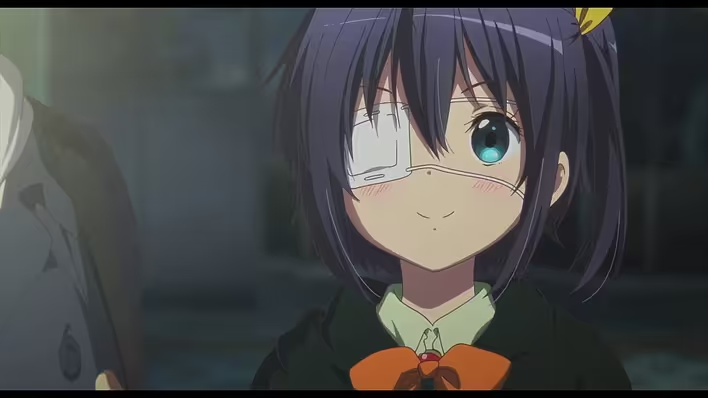
A typical character of this kind might refer to their hand as cursed, wear a bandage that supposedly restrains the power of their eye, invent attack names, see around them the activities of a secret organization, or use a complex pseudonym instead of a regular name.
The term became especially recognizable thanks to "Chūnibyō Demo Koi ga Shitai!" (Love, Chunibyo & Other Delusions!). Initially, this was a light novel by Torako, and later Kyoto Animation created its anime adaptation.
The main character, Yuta, tries to forget his own chūnibyō period, while Rikka still lives in a world of fantastic powers and calls her ability "the Eye of the Evil King." Even the official description of the first volume from Kyoto Animation begins with Yuta's admission that he had chūnibyō in middle school and now wants to leave that "dark past" behind.
The work itself, however, did not invent the concept. The first volume was released only in 2011, while the word chūnibyō had been used since the late 1990s.
Is chūnibyō only for teenagers?
Despite the origin of the name, today the word is no longer tied to a specific age.
Chūnibyō can humorously describe the behavior of an adult if they too demonstratively build an image around themselves as a mysterious genius, a dangerous loner, or a personality that supposedly stands above "ordinary people."
The term can even describe not a person, but a certain aesthetic. "Chūnibyō-style" or "chūnibyō-design" can refer to something deliberately grandiose and gloomy: with demons, blood, fate, forbidden powers, Latin words, and extremely complex attack names.
Thus, modern chūnibyō is no longer just "the strange behavior of an eighth grader." It is a recognizable cultural image built on a mix of adolescent maximalism, fantasy, the desire to seem special, and that slight awkwardness that often arises when recalling one's attempts to be more mysterious and mature than one actually was a few years later.
Like it?React
🧵
This post doesn't have any additions from the author yet.