This content has been automatically translated from Ukrainian.
A few years ago, the word “alt girl” was hardly encountered outside of social networks. Today, however, you can hear it on TikTok, see it in comments under videos, read it in memes, or even in casual conversations. Some use this term as a compliment, others as a joke, while some don’t fully understand whom it refers to.
In reality, the concept of alt girl is much more complex than it may seem. It is not a separate youth subculture like punks, goths, or emos, but a modern internet aesthetic that combines elements from many fashion trends, music scenes, and youth cultures.
That’s why there are almost no two identical alt girls. Each creates her own image by combining different elements in a way that suits her.
What does the word “alt girl” mean
The word alt is short for the English alternative, meaning “alternative”.
In the West, the term alt girl is used much more frequently, while in the Ukrainian internet, the variants альт-дівчина and альтушка have become widespread.
Despite the literal translation, the word “alternative” does not mean that a person necessarily belongs to any alternative subculture or listens only to alternative music.
In modern understanding, an alt girl is a girl who consciously combines elements from different aesthetics and does not strive to conform to traditional fashion templates. She can be inspired by goth, punk, grunge, emo, Japanese street fashion, or even the aesthetics of the early 2000s.
The freedom to combine different directions has become the main feature of this image.
How alt girls emerged
Contrary to popular belief, the alt girl style did not emerge “out of nowhere”.
Its appearance was the result of the development of several generations of youth culture.
Back in the 1970s, punks emerged, making fashion rebellion a part of their culture. In the 1980s, goths gained popularity with their gloomy aesthetic, and in the early 2000s, the world was swept by the emo and scene culture wave.
The next important stage was the Tumblr era. This platform popularized the fashion of combining different styles, independent music, artistic photography, and individuality, which later became one of the sources of inspiration for alt girls.
When Tumblr's popularity began to decline, TikTok took up the baton. It was there that around 2019-2020, the alt girl style turned into a global internet trend.
Short videos made it easy to showcase makeup, hairstyles, clothing, and musical preferences, and the platform's algorithms helped the new aesthetic spread rapidly among the youth.
Alt girl is not a subculture
One of the most common misconceptions is to consider alt girls a separate subculture.
In fact, there is a fundamental difference between them and, for example, goths or punks.
Classic subcultures usually have their own history, characteristic music, symbolism, certain shared values, and worldview.
The alt girl operates quite differently.
What unites them is primarily a shared aesthetic, not ideology. A person can look like an alt girl but listen to any music, have different political or religious views, and be interested in completely different things.
That’s why researchers of modern internet culture often describe the alt girl not as a subculture, but as a digital aesthetic or style.
What does an alt girl look like
There is no universal image of an alt girl, but some traits occur particularly often.
She is easily recognizable by her bold combinations of items that just a few years ago would hardly have been found in the same wardrobe.
Baggy jeans can be paired with a mesh top, a plaid shirt, chunky boots, a choker, and a lot of metal accessories. Some choose black clothing with gothic elements, while others add bright colors, eclectic prints, or items in Y2K aesthetics.
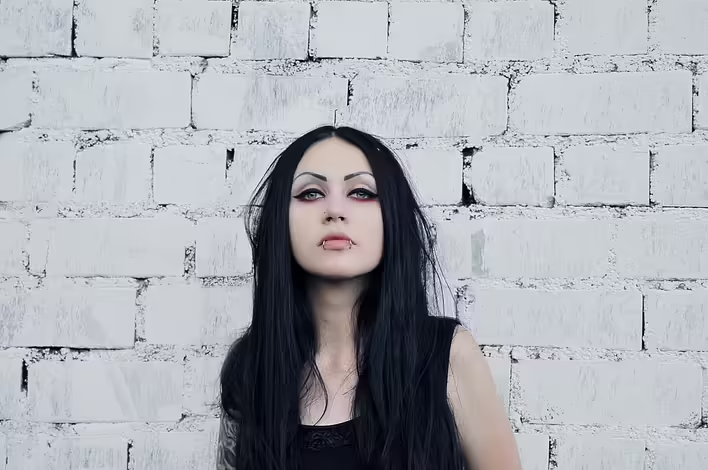
Similarly, there are no strict rules regarding hairstyles or makeup. Some dye their hair in bright colors, while others keep their natural shade but opt for unusual haircuts. It’s common to see graphic eyeliner, dark eye makeup, piercings, or chokers.
The main feature of this image lies not in individual items but in their combination. An alt girl does not strive to fully adhere to any one direction — on the contrary, she creates her own style from the details she likes.
How alt girl differs from e-girls, emos, and goths
Due to similar clothing elements, these styles are often confused.
The closest to an alt girl is considered to be the e-girl. Both aesthetics became popular thanks to TikTok, but there is an important difference between them.
E-girls are much more closely associated with digital culture, anime, streaming, and bright, almost “doll-like” makeup. Their image usually appears more stylized and easily recognizable.
Alt girls, on the other hand, leave much more freedom for experimentation. They combine elements of punk, grunge, goth, skater fashion, Y2K, and other directions without being bound by strict rules.
It’s also important not to confuse alt girls with emos. Despite certain external similarities, emos are a separate subculture with its own history, music scene, and characteristic aesthetic that formed back in the early 2000s.
The same goes for goths. Dark clothing or black makeup alone does not make someone a representative of the gothic subculture.
The freedom to combine different aesthetics without adhering to strict rules has become one of the main reasons for the popularity of alt girls among modern youth.
In the second part, we will discuss the musical preferences of alt girls, explain how this style turned into an internet meme, whether it has a common worldview, and why today the word “alt girl” can have completely different meanings depending on the context.
What music do alt girls listen to
Music has always been an important component of alternative culture, so it’s no surprise that it is often associated with the image of an alt girl. At the same time, there is no list of artists that every alt girl must listen to.
Unlike classic subcultures, where music often defined belonging to a certain community, modern internet aesthetics are much freer. Today, one person can equally love rock, indie pop, shoegaze, electronic music, and alternative hip-hop.
However, there are artists that are particularly often associated with the alt girl image. Among them are Deftones, Mitski, Bring Me the Horizon, Paramore, The Neighbourhood, Lana Del Rey, Arctic Monkeys, TV Girl, Crystal Castles, Slowdive, and Radiohead.
However, this is more a reflection of modern internet trends than a rule. In reality, the musical preferences of alt girls can be very diverse.
Is there a common worldview among alt girls?
Another common stereotype is that all alt girls supposedly view the world in the same way.
In reality, this is not the case.
Punks were associated with protest culture, goths with their own aesthetics and art, and representatives of many other subcultures were also united by common ideas.
In the case of alt girl, the situation is quite different.
This direction almost lacks a unified ideology or value system. People can have different views on politics, art, fashion, or lifestyle. What unites them is primarily the desire for self-expression through appearance, not a shared worldview.
That’s why researchers of digital culture often describe the alt girl as an internet aesthetic rather than a classic subculture.
How alt girl became a meme
Interestingly, in the Ukrainian internet, the word “alt girl” quickly began to live its own life.
While the English alt girl is usually used as a neutral term for a certain aesthetic, the word “alt girl” often has a humorous or ironic connotation.
On TikTok, Instagram, and other social networks, numerous memes about the “typical alt girl” have emerged — her style of clothing, musical tastes, love for anime, coffee, vintage items, or creative hobbies.
Of course, most of these jokes are based on exaggerations. In reality, there is no universal image that fits all representatives of this aesthetic.
Thanks to memes, the word “alt girl” has gradually become part of modern internet slang and is now often used even by people far removed from alternative fashion.
Is this style popular today?
The biggest surge in popularity of the alt girl occurred around 2020-2022, when TikTok became the main platform for developing new fashion trends.
However, this does not mean that the direction has disappeared.
On the contrary, many of its features have gradually become part of modern youth fashion. Chunky shoes, baggy clothing, chokers, and combinations of grunge with Y2K aesthetics or elements of punk can now be seen even in collections from well-known brands.
What was considered a characteristic feature of alt girls just a few years ago has gradually become a common element of everyday wardrobes.
Why is there so much controversy around alt girls
The popularity of any internet trend is almost always accompanied by discussions.
Some see in alt girls a manifestation of creative freedom and the opportunity not to conform to fashion standards. Others call this direction yet another fleeting trend that became popular thanks to social media algorithms.
Both points of view have certain grounds.
Like most modern internet aesthetics, the alt girl is constantly changing, borrowing elements from other directions while also influencing new fashion trends.
Today, the word “alt girl” can mean different things depending on the context. For some, it’s a way of dressing, for others, it’s an internet meme, and for others, it’s a form of creative self-expression.
Despite common stereotypes, the alt girl is not a separate subculture with a shared ideology or strict rules. It is a modern internet aesthetic that emerged at the intersection of music, fashion, social media, and digital culture.
Perhaps that’s why it has proven to be so viable. Instead of dictating how one should look or behave, the alt girl offers a different idea — to freely combine various sources of inspiration and create one’s own, unique image.
Like it?React
🧵
This post doesn't have any additions from the author yet.