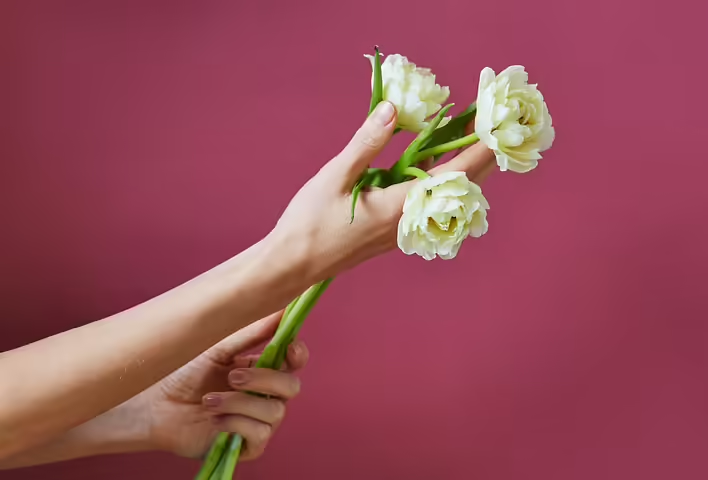
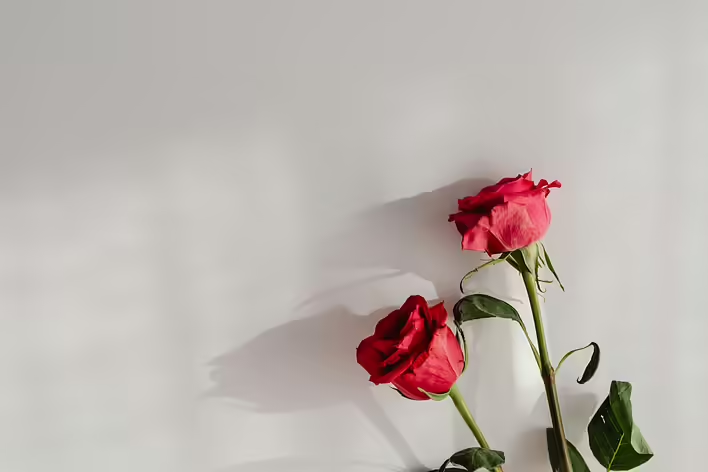
The tradition of counting flowers in a bouquet has ancient symbolic roots. It is connected to notions of life, death, and the harmony of numbers that formed in pre-Christian times. An odd number has long been considered “alive” — one that cannot be divided in half, and therefore symbolizes movement, development, and the continuation of life. An even number, on the contrary, has been perceived as completion, calmness, and the symbolic “fullness of the circle,” that is, the end. That is why an odd number of flowers has become a sign of wishing life, while an even number is a tribute to the deceased.
This tradition is most widespread in Eastern European countries, particularly in Ukraine, Belarus, Latvia, Lithuania, Poland, and partially in Georgia. In these cultures, an even number is associated with burials or memorial rituals. Therefore, for example, a bouquet of two or four flowers is not traditionally given for a birthday or wedding — it is considered bad luck.
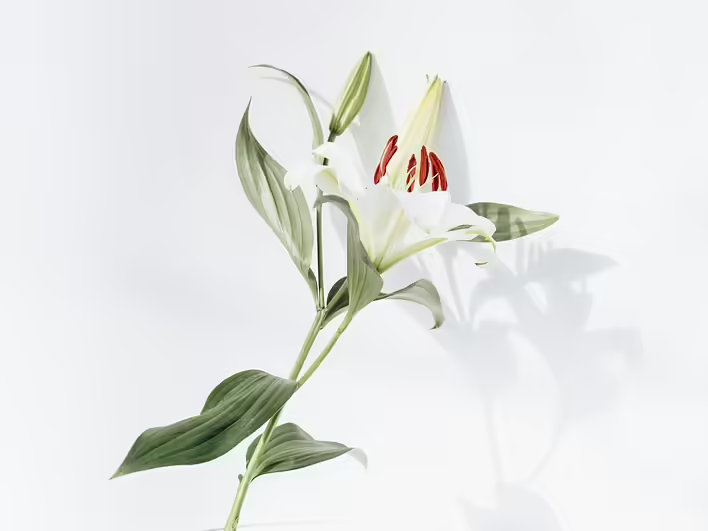
In Western Europe, on the contrary, there are no such superstitions. There, the number of flowers in a bouquet does not have symbolic meaning, and people give as many as they find beautiful or appropriate. The French, Italians, or British pay more attention to the color and type of plants: red roses signify love, white lilies — purity, and yellow tulips — joy and friendship.
Interestingly, in Japan, they also place great importance on the symbolism of numbers: they avoid giving four flowers, as the word “four” sounds similar to the word “death.” A similar taboo exists in China, where even wrapping gifts with four items can be perceived as a hint of misfortune.
Thus, the division into “odd for the living, even for the dead” is a cultural heritage that combines ancient beliefs and elements of symbolic thinking. And although fewer people in the modern world contemplate the number of flowers, the tradition retains its strength — as a manifestation of respect, tact, and cultural memory.