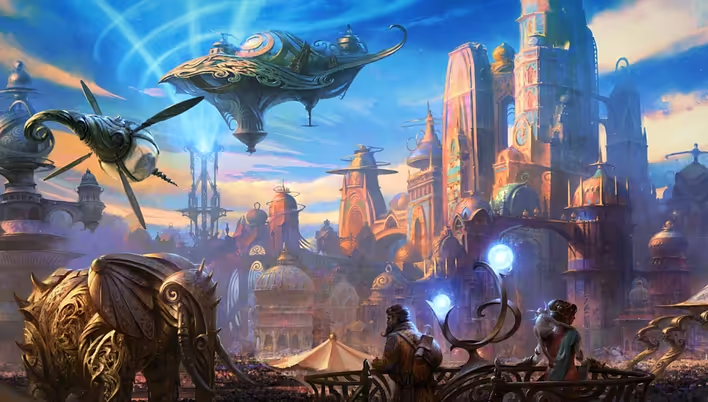
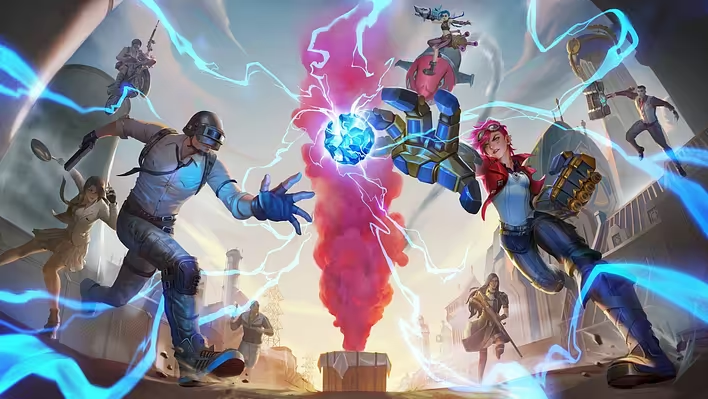
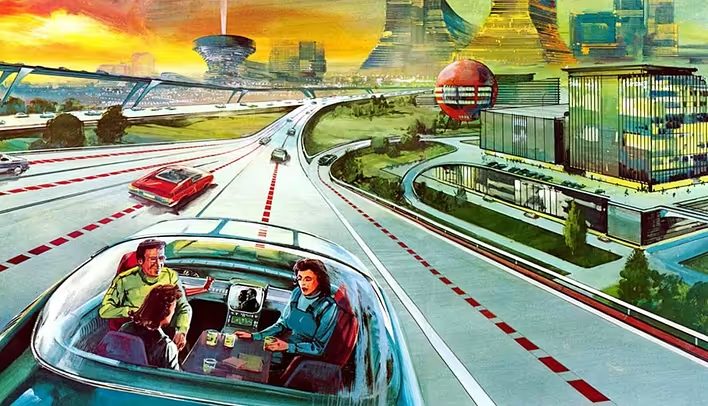
In most fantasy works, magic and technology exist separately. Wizards create spells, and inventors build machines. Some rely on ancient knowledge, while others depend on science and engineering.
However, some authors have posed a different question: what if magic itself becomes technology?
This concept is often referred to today as magitech. It is one of the most interesting ways to build fantasy worlds where magical energy serves the same functions as electricity, engines, communication networks, or computers in our world.
What is magitech
The term magitech comes from the English words magic and technology.
This term usually describes fictional worlds where magic is used not only for sorcery but also as a foundation for everyday life. It can provide energy to cities, power transportation, serve as communication means, or replace complex technical devices.
Unlike traditional fantasy, where magic often remains a mysterious force accessible only to a few, in worlds with magitech, it resembles familiar infrastructure. It is used as naturally as we use electricity, mobile communication, or the internet.
At the same time, magitech is not considered a separate literary genre. It is rather a term that describes a way of building a fantasy world. This concept can be found in fantasy, science fiction, alternative history, and many other genres.
How magical technology works
In most worlds with magitech, magic follows certain rules.
It can accumulate in crystals, be transmitted through special channels, be stored in artifacts, or activated using complex symbols and spells. In some works, magical energy is even studied similarly to how we study physics or chemistry in our world, with mages taking on the roles of engineers, scientists, or inventors.
As a result, magic ceases to be merely a wonder or a rare gift. It becomes a resource that can be researched, refined, and used to create new devices, transportation, or entire urban systems.
This idea has made magitech a popular concept in modern fiction, especially in literature, animation, and video games.
Best examples of magitech in books, games, and animation
Although the word magitech is not familiar to everyone, the concept itself has long become an integral part of modern fantasy. Today, it can be found in novels, video games, animated series, comics, and tabletop role-playing games.
In each case, magic ceases to be just a mysterious force and gradually transforms into the foundation for the development of an entire civilization.
Magitech in literature
Clearly defined worlds with magitech in literature are not as common as in video games, but some authors actively use this concept.
One of the most famous examples is the work of Brandon Sanderson. In many of his novels, magical systems have strict rules, limitations, and even resemble a separate scientific discipline. The heroes do not just possess supernatural abilities; they explore them, experiment, and find new ways to apply them practically. Although not all of Sanderson's worlds can be called examples of magitech in the narrow sense, his approach has significantly influenced modern fantasy with well-thought-out magical systems.
Interesting examples can also be found in contemporary epic fantasy, where magic gradually becomes the basis for societal development, although it does not always take the form of a full-fledged technological infrastructure.
Magitech in video games
Video games have made the concept of magitech particularly popular among fantasy fans.
One of the most well-known examples is the Final Fantasy series. In various installments of the franchise, magical energy is used to power transportation, weapons, combat machines, and even entire cities. Depending on the specific game, its source can be crystals, magical reactors, or other fantastical resources.
The concept of magitech is also widely represented in many Japanese role-playing games (JRPGs), where magic is not only a combat force but also the basis for the development of civilization. One of the best examples is the The Legend of Heroes: Trails series, where almost all technological infrastructure is built on so-called Orbments — magical devices that power transportation, communication means, weapons, and other mechanisms. A similar approach can be seen in many other JRPGs, where magic performs the same functions that modern technologies provide in the real world.
Final Fantasy VII Revelation
Magitech in animation
In recent years, one of the most famous examples of the use of the magitech concept has been the series “Arcane”.
In the cities of Piltover and Zaun, magic ceases to be just a mysterious supernatural force. Thanks to Hextech technology, it can be controlled and used to create weapons, transportation systems, medical devices, tools, and other inventions.
Hextech is often referred to as one of the brightest modern examples of magitech, as in this world, magical energy becomes the foundation for scientific and technological progress.
Arcane
How magitech differs from traditional fantasy
The main difference lies in the role of magic.
In classic fantasy, it usually remains an exceptional ability of individual characters. Magical items are rare, and their creation is considered an art or even a miracle.
In worlds with magitech, the situation is quite different.
Here, magic becomes part of everyday life. It powers transportation, lighting, industry, medicine, or communication means. In other words, it performs the same functions that modern technologies fulfill in the real world.
That is why such worlds often seem closer to science fiction than to traditional fantasy.
Magitech allows authors to combine two things that have long seemed incompatible — magic and technological progress.
This makes fantasy worlds appear more logical and cohesive. Supernatural forces cease to be random wonders and transform into a resource that can be researched, refined, and used for societal development.
This idea has made magitech one of the most interesting concepts in modern fiction.