This content has been automatically translated from Ukrainian.
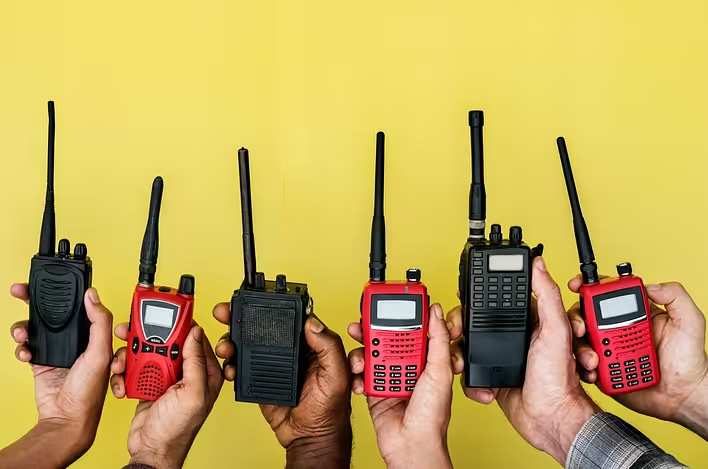
Radios are not just a communication device. They represent a whole culture of short, clear, and understandable phrases that emerged long before messengers and even telephones. When the sound crackles, the signal is weak, and time is short — the speech must be as precise as possible. That is why a special vocabulary has developed in the world of radio communication. Among the most well-known phrases is "roger that".
How a radio works
Unlike a telephone, a radio does not work simultaneously in both directions. The principle here is: only one person speaks — the other listens. To say something, you need to press a button (often called PTT — push-to-talk), and at that moment the device transmits your voice as a radio signal. When you release the button — you can listen again.
This means that interlocutors must speak in turn, and that is why special words like "received" or "over" have appeared in radio communication — they signal that the phrase is complete and now a response can be given.
The principle itself is quite simple: the voice is converted into a radio wave, it is transmitted through the air, and the other radio receives this signal and converts it back into sound. However, due to possible interference, it is important to speak clearly and briefly — hence all this "radio language".
In Ukrainian and generally post-Soviet practice, we are used to hearing "received" — a word that signals: I have finished my message and am waiting for a response. This is a simple and logical marking of the end of a reply. But in the English-speaking world, it is a bit different — they use a whole system of code words, and "roger" is just one of them.
What "roger that" means
The phrase "roger that" literally means "understood" or "message received". Importantly: this does not end the conversation, but confirms that the information has been received without errors.
The word "roger" does not come from a name, as it may seem, but from the old radio alphabet. In the first half of the 20th century, before the modern phonetic alphabet, each letter had its own word. The letter R (from received) was designated by the word "Roger".
During World War II, radio communication became critically important: there was no room for misunderstandings in military operations. It was then that "roger" became established as the standard confirmation of message receipt. Later, even after the transition to the modern phonetic alphabet (where R is now "Romeo"), the word "roger" remained in use due to its recognizability.
The addition of "that" is a conversational form that reinforces the meaning: "yes, I understood this message specifically".
Why it is not "end of communication"
This is an important point that is often confused due to movies. "Roger that" does not mean that the conversation is over. It is merely a confirmation. After it, the dialogue can continue.
To end a conversation in English-language radio communication, other words are used:
- "Over" — I have finished speaking and am waiting for a response
- "Out" — communication is complete, no response is needed
- "Over and out" — a popular but technically incorrect phrase (because it combines opposite meanings)
Who and where says "roger that"
The phrase "roger that" is widely used:
- in the military (especially in the USA and NATO countries)
- in aviation
- among amateur radio operators
- in movies and pop culture (often even more broadly than in real life)
For example, in NATO standards, radio communication is highly formalized, and although more precise formulations are often used there, "roger" is still understood and acceptable.
The Ukrainian "received" and its logic
The word "received" works differently. It does not mean "I understood", but rather:
"I have transmitted the message and am ready to receive a response".
Thus, it is closer to the English "over" than to "roger".
In this sense, the difference is very indicative:
- "received" — about the structure of the dialogue
- "roger" — about confirming the content
Why these words appeared at all
Radios operate in an environment where:
- sound can be distorted
- the signal can be interrupted
- there are no non-verbal cues (gestures, facial expressions)
Therefore, the language of radio communication has become maximally functional. Every word has a clear meaning and does not allow for ambiguity. It is a kind of minimalism in communication — nothing superfluous, just meaning.
Like it?React
🧵
This post doesn't have any additions from the author yet.