This content has been automatically translated from Ukrainian.
The concept of eco-city began to develop in the 1970s under the influence of increasing attention to the ecological problems of humanity and the greening of all spheres of human activity
The scientific foundations and first practical movements in this direction at the global level began to take shape after the initiation of international eco-city forums, the first of which took place in 1990 in Berkeley (USA)
Ideally, green cities, eco-cities are cities with vast areas of green spaces, clean air, clean water, clean energy, a high percentage of recycled waste, green transportation, and, accordingly, healthy urban residents
An eco-city is a city designed with consideration for environmental impact, inhabited by people who strive to minimize energy and water consumption, eliminate unreasonable release of thermal energy, air pollution from carbon dioxide and methane, as well as water pollution
The term "eco-city" was first used by Richard Register in 1987 in the book "Eco-City Berkeley: Building a City for a Healthy Future"
Key components of urban ecologicalization
- the development of renewable energy within the city, namely wind, solar, geothermal, etc., depending on the natural conditions of the area
- the construction of energy-efficient buildings that consume minimal electrical and thermal energy
- reducing the need for automobile transport through optimal land planning, the development of bicycle transport, and the efficient operation of public transport in the city
- ensuring a high percentage of green spaces within urban areas and the resilience of natural systems and biodiversity within them
- minimizing the generation of solid waste, ensuring its sorting and maximum deep recycling
Variations of eco-cities
1. Eco-cities — large-scale "projects of the future"
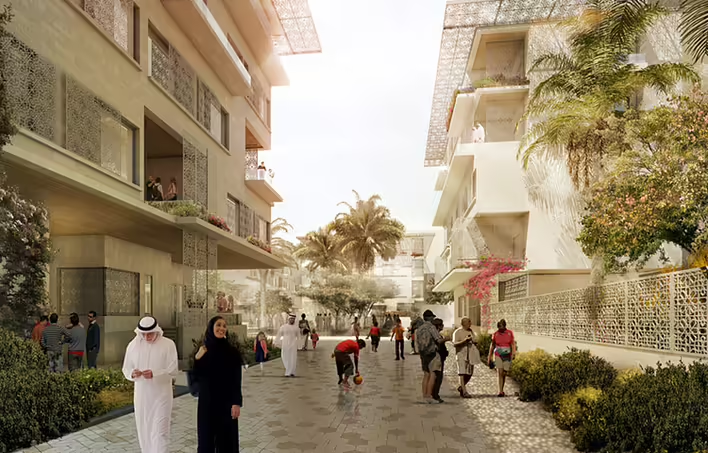
Not fully completed, developed by countries to stimulate fundamental research in the field of cutting-edge engineering developments and showcase the scientific potential, as well as demonstrate the financial capabilities of the country
Example: the city of Masdar (UAE) (total project cost $22 billion)
2. Eco-cities near developed urban settlements
Example: eco-satellite city Great-city near Chengdu (China) (designed for 80,000 residents)
3. Eco-districts — reconstructed urban areas
The most developed in Europe, due to gentrification processes, as well as the obsolescence and inefficiency of the urban housing stock
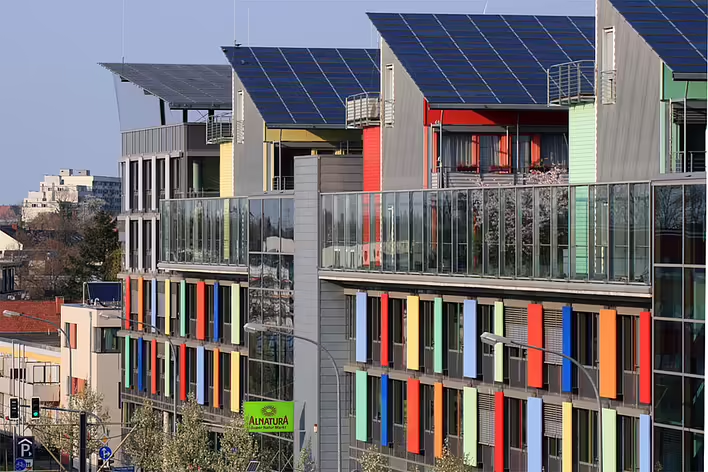
Example: Woban district in Freiburg (Germany), built on the site of a former French military base in 2000, where a high level of energy efficiency is ensured through solar and geothermal energy
Other examples of ecological reconstruction include
- eco-city Austenburg in Malmö (Sweden),
- Neubau district in Vienna (Austria),
- residential area in Coldingen (Germany)
4. Small eco-settlements in ecologically clean areas
Primarily serve the functions of residential zones but can also become educational, scientific, or recreational centers
Example: the cottage settlement St. David's (Wales, United Kingdom) (the smallest city in the country (2,000 people), entirely located within the Pembrokeshire Coast National Park)
5. Large cities characterized by high levels of economic efficiency, social living standards, and ecological stability
Example:
San Francisco (USA)
Vancouver (Canada)
Copenhagen (Denmark)
Malmö and Stockholm (Sweden)
Like it?React
🧵
This post doesn't have any additions from the author yet.