This content has been automatically translated from Ukrainian.
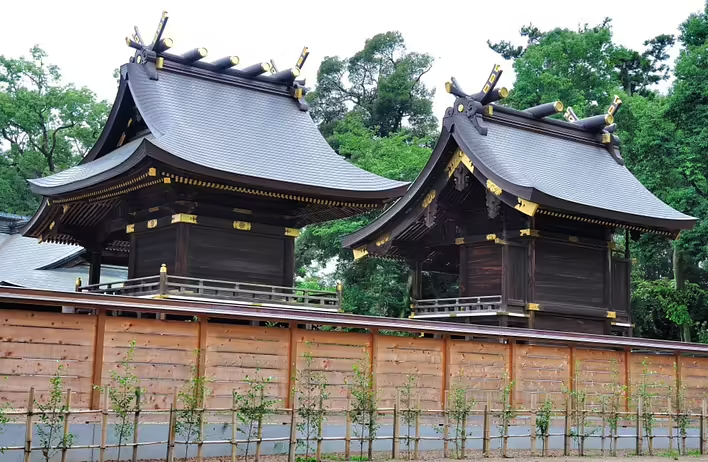
Chigi — bifurcated tips found in Japanese Shinto architecture. Chigi originated before the Buddhist influence and is an architectural element characteristic of Japan.
They are an important aesthetic aspect of Shinto shrines, where they are often combined with Katsuogi, another type of roof ornament. Today, Chigi and Katsuogi are exclusively used on Shinto buildings, distinguishing them from other religious structures, such as Buddhist temples in Japan.
The Origin of “Chigi”
It is believed that chigi were used on Japanese buildings starting from the 1st century AD.
The evolutionary origin of chigi is unknown. One theory suggests that they simply connected boards that remained uncut.
Another theory posits that they were part of a support system anchored to the ground to stabilize the roof.
Yet another theory suggests that they were used to "pinch" and hold thatched roofing. Evidence of this can be seen in minka (folk houses built in one of several traditional Japanese architectural styles), or ordinary traditional houses, where two interlocked timbers are often found on the gables of the roof.
However, the only verifiable fact is that originally chigi were a working part of the structure, but with advancements in construction techniques, their function was lost, and they were left as decorations.
Chigi likely adorned only the houses and warehouses of powerful families, and more decorations indicated a higher rank. This tradition persisted until relatively recently. In the 17th–19th centuries, legal codes dictated how many chigi were allowed on the roofs of buildings according to the owner's social status. Today, chigi are found only on Shinto shrines.
Where and How “Chigi” is Used
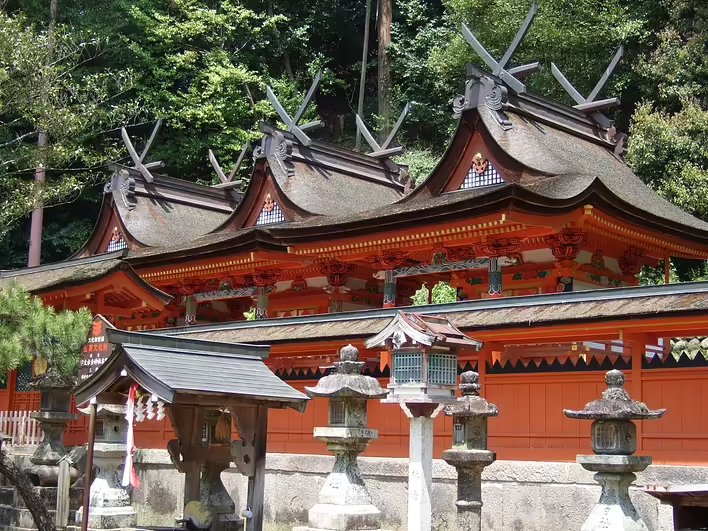
Chigi can be embedded directly into the roof as part of the structure or simply attached and crossed on the gable as decoration. The first method is believed to resemble its original design more closely and is still used in old construction methods, such as shinmei-zukuri, kasuga-zukuri, and taisha-zukuri. Chigi that are not embedded in the building are crossed and sometimes cut with a slight bend. Although chigi are predominantly placed only at the ends of the roof, this method allows them to sometimes be placed in the middle as well.
More elaborate chigi, such as those at Ise Shrine, are carved with one or two kaza-ana (wind openings) and a third open cut at the tip, giving it a bifurcated appearance. Gold metal coverings serve both protective and decorative purposes.
Overall, “Chigi” is now exclusively a decorative element on Shinto shrines, but we can also find it on houses. “Chigi” is an ornament that symbolizes various aspects of Japanese culture and beliefs and conveys traditional style and heritage in architecture in Japan.
Like it?React
🧵
This post doesn't have any additions from the author yet.