This content has been automatically translated from Ukrainian.
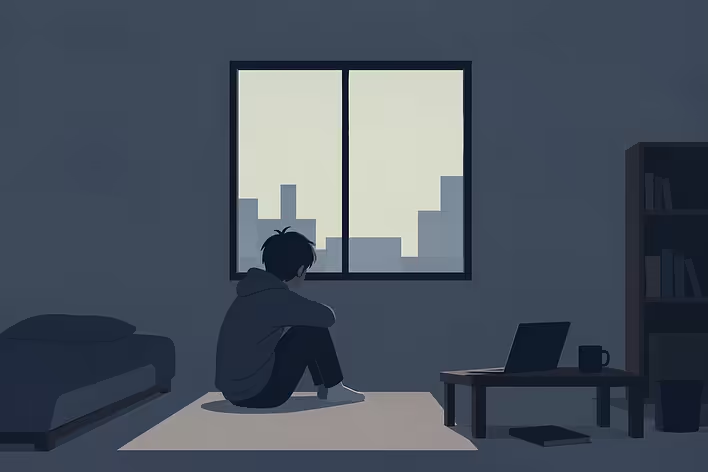
The word hikikomori often appears in anime, manga, Japanese pop culture, and the internet. Because of this, outside of Japan, it is sometimes perceived almost as a label for a certain type of character: a person who does not like to leave home, spends a lot of time on the computer, and avoids company.
In reality, the meaning of the term is more serious. Hikikomori is not just an introvert, a homebody, or a person who has decided to spend a few weeks alone. It refers to a state of prolonged social withdrawal, during which a person largely ceases education, work, communication, and other forms of participation in life outside the home.
What hikikomori means in simple words
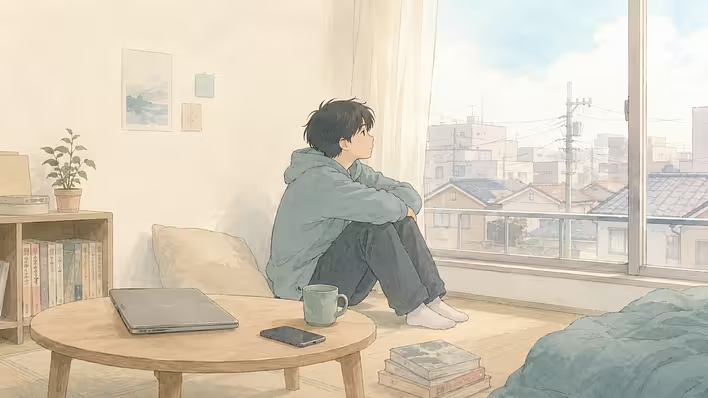
Hikikomori is a state of prolonged and pronounced social isolation, where a person spends most of their time at home and significantly limits contacts and participation in public life.
In the classic definition by the Japanese Ministry of Health, Labor, and Welfare, it refers to avoiding education, work, and communication and predominantly staying at home for at least about six months. At the same time, a person does not necessarily stop going outside altogether: this category can also include those who go out alone, without interacting with others.
Six months remain a common benchmark in scientific research. For example, in the proposed modern research criteria, hikikomori is described through noticeable social isolation at home, its duration of six months, and associated difficulties in functioning or psychological discomfort.
However, there is an important modern clarification here. In a new Japanese guideline for supporting hikikomori, published in 2025, the state moves away from a too rigid definition of who has been in isolation "long enough" to receive help. The emphasis is placed on specific life difficulties, loneliness, limited contacts, and the needs of the person, rather than just on a formal count of months.
What the word "hikikomori" means
In Japanese, the word is written as ひきこもり or 引きこもり (hikikomori). It is related to the verb 引きこもる — hikikomoru, which means to shut oneself in at home, to isolate oneself, to withdraw from social life.
The word itself was not invented at the end of the 20th century. The Japanese hikikomoru has existed for a very long time: the dictionary Nihon Kokugo Daijiten cites an example of its use in a text dated around 1220. At that time, of course, it did not denote the modern social phenomenon but had a common meaning like "to isolate oneself," "to withdraw and stay inside."
Therefore, the widespread claim that the word "hikikomori" was invented by Japanese psychiatrist Tamaki Saito in 1998 is not entirely correct.
What does Tamaki Saito have to do with it
A huge role in the word acquiring its modern meaning was played by Japanese psychiatrist Tamaki Saito (斎藤環).
In 1998, he published a book “Shakaiteki Hikikomori: Owaranai Shishunki” — “Social Hikikomori: Endless Adolescence,” the English translation of which later came out under the title Hikikomori: Adolescence without End.
Saito described young people who remained at home for a long time and effectively dropped out of education, work, and social life. His book attracted enormous attention from the Japanese media and society to the issue.
Is hikikomori a mental disorder?
Not exactly.
Hikikomori is not a separate, standalone diagnosis in international classifications of mental disorders like DSM-5 or ICD-11. Researchers rather describe it as a syndrome, condition, or form of prolonged social withdrawal.
At the same time, hikikomori can be associated with other conditions and disorders. Studies among people with prolonged social isolation reveal, among other things, depressive and anxiety disorders, social anxiety, developmental disorders, and other psychiatric problems.
But one does not equal the other. Not every person with depression becomes hikikomori, and not every case of hikikomori can be explained by one specific mental disorder. That is why modern research criteria no longer require automatically excluding hikikomori if a person has another psychiatric diagnosis.
Hikikomori is not the same as being an introvert
These concepts are especially often confused on the internet.
Introversion is a temperament trait and a way of interacting with others. An introvert may love solitude, tire more quickly from large groups, and prefer a few close people over dozens of acquaintances.
At the same time, they can very well work, study, travel, build relationships, and have an active social life.
Hikikomori is no longer just a desire to be alone. It refers to a significant narrowing of social life that can last for months or years.
Therefore, a person who works from home, does not like parties, and spends weekends with a book does not automatically become hikikomori.
Is it necessary for hikikomori to never leave their room
No. This is one of the most persistent stereotypes.
The most severe cases may indeed look like this: a person hardly leaves their own room and avoids even family members.
However, there are different degrees of social withdrawal. In Japanese studies, a broader category of hikikomori includes people who go to the nearest store or leave home for their own hobbies but practically do not participate in social life. The official Japanese definition also explicitly allows leaving home without interacting with other people.
Thus, the key factor is not the physical boundary of the apartment door itself, but the degree of social withdrawal.
Similarly, a person can use the internet, play online games, read social networks, or even have online acquaintances while remaining almost completely isolated from offline life.
Why do people become hikikomori
There is no single reason that would explain all cases.
Prolonged isolation can be preceded by difficulties in school or university, problems at work, conflicts, unsuccessful social contacts, refusal to attend school, psychological problems, or other complex life circumstances. Research also examines the role of family environment and mental health, but hikikomori cannot be reduced to any one cause.
The modern Japanese approach to support particularly emphasizes the concept of 生きづらさ — ikizurasa, which can be roughly translated as "difficulties of life," "the feeling that living in society is hard." Behind the same external state of isolation can lie very different stories.
Therefore, the explanation "the person is just too lazy to work" is not only overly simplistic but also poorly corresponds to the modern understanding of the phenomenon.
Is hikikomori a purely Japanese phenomenon?
The term itself and its social understanding indeed originate from Japan. Therefore, early researchers paid much attention to the peculiarities of Japanese education, family, employment, and societal expectations.
For a long time, there were even debates about whether hikikomori is a phenomenon specific to Japanese culture.
Over time, similar cases began to be systematically described in other countries. Research has been conducted, in particular, in South Korea, China, Spain, France, Italy, the USA, and other states. Today, more and more researchers view prolonged social withdrawal as a phenomenon that is not limited to Japan, although culture can significantly influence its form and perception.
Hikikomori is not just young men
The popular image of hikikomori has mainly formed around a young Japanese man living with his parents and hardly leaving home for years. However, modern data shows a much more diverse picture.
In a large government study “こども・若者の意識と生活に関する調査(令和4年度)” conducted in Japan in 2022, social withdrawal among people of different ages was studied separately. The so-called "broad hikikomori group" included 2.05% of respondents aged 15–39 and 2.02% among those aged 40–64. In terms of the country's population, this gave a widely cited estimate of approximately 1.46 million people aged 15 to 64, or about one person in fifty.
Importantly, this is a statistical estimate based on survey results, not the number of people who have officially been given any diagnosis. The authors of the study also warn that the definition used may not cover all real cases of hikikomori and may include individuals whose situation differs from the typical understanding of this condition.
A significant group of middle-aged people also exists. With age, a separate Japanese social problem has even emerged, known as “8050”: a situation where about 80-year-old parents continue to financially support a 50-year-old child who has been socially isolated for many years.
This clearly shows why hikikomori can no longer be considered exclusively a problem of teenagers, students, or young men.
Hikikomori in anime and internet culture
Outside of Japan, many people first encountered the word thanks to anime, manga, light novels, and the internet. One of the most famous works on this topic is the novel by Tatsuhiko Takimoto “Welcome to the N.H.K.”, published in 2002 and later adapted into manga and anime.
In pop culture, the image of hikikomori is often exaggerated: the character does not leave the room, lives among boxes of food, sits at the computer around the clock, and is almost unable to talk to people.
Because of this, the word itself has taken on a much lighter, joking meaning on the internet. Someone might say, "This weekend I'm going hikikomori," meaning only that they plan to stay home, play, read, or watch series.
This usage has strayed quite far from the meaning the term has in Japanese research and social policy. Two days at home without a desire to see friends is not hikikomori.
Therefore, today the word effectively exists in two contexts. In internet slang, it can be a humorous designation for extreme homebody behavior, while in scientific and Japanese societal contexts, hikikomori refers to prolonged social withdrawal that can seriously change a person's life and their family's.
Like it?React
🧵
This post doesn't have any additions from the author yet.