This content has been automatically translated from Ukrainian.
The Ukrainian language is rich and logical, but sometimes we encounter the influence of other languages that penetrates even the most mundane expressions. One such borrowing is the abbreviation b/v – "been in use." At first glance, this seems like a correct Ukrainian variant, but in reality, it is an adaptation of the Russian b/u ("бывший в употреблении"), which does not conform to the norms of our language. So, how should we speak correctly?
Why "been in use" is not the best option?
The abbreviation b/u in the Russian language means "бывший в употреблении," and in Ukrainian, its formal translation appeared – b/v, meaning "been in use." However, this expression does not reflect the stylistics and logic of the Ukrainian language.
- The word "been" is unnecessary. Used items are those that have already been used, and this is already clear without the clarification "been."
- A calque from Russian. The translation of the expression b/u as "been in use" is a direct copying of the Russian structure, which contradicts the Ukrainian speech standard.
In Ukrainian, it is more correct and appropriate to say used items or used goods. This not only conforms to language norms but also sounds more natural.The option "used goods" is less desirable, as the word "used" is usually employed in the meaning of "mastered, accepted for use" (for example, "used in language expression"). In this context, "used goods" may sound ambiguous and even incorrect.
The history of the concept of used items
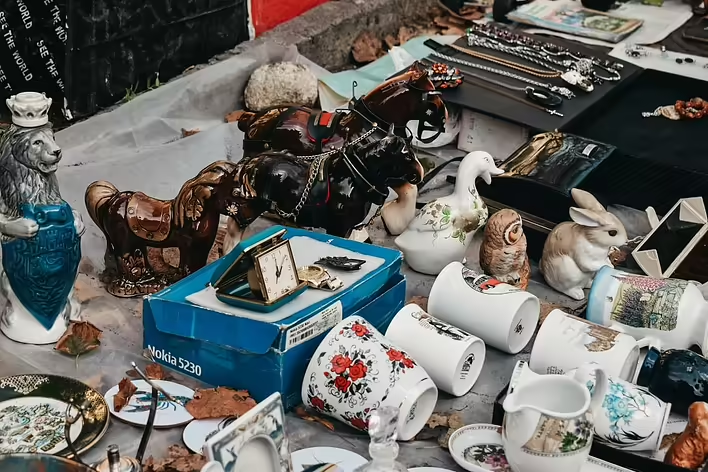
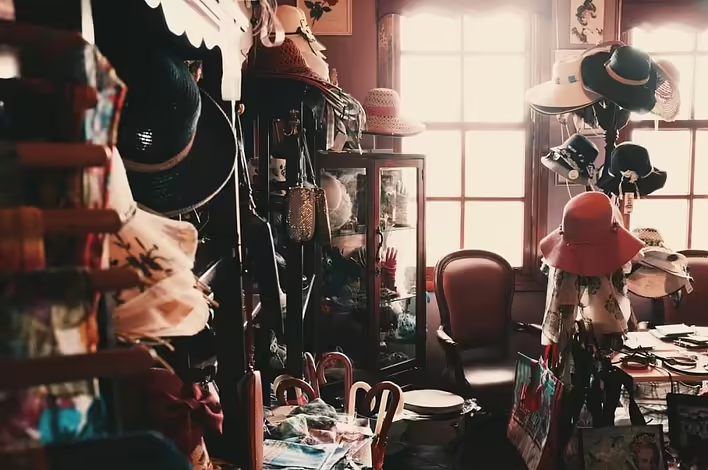
The concept of used items appeared long before modern trends. In ancient times, the transfer of items between generations was a common practice. Clothes were altered, furniture was restored, and household items served for decades.
During Soviet times, due to a shortage of goods, used items became a necessity. In the 90s, second-hand stores, consignment shops, flea markets, and exchanges gained popularity. At that time, this process was perceived utilitarian – not as a choice, but as a forced step.
Today, buying used items is not only an economic choice but also an ecological one. People consciously prefer goods that have already been in use, reducing resource consumption.
How to speak better?
To avoid language mistakes, choose the correct options:
- Used items. This is a natural, literary equivalent that fully complies with Ukrainian norms.
- Used goods. Suitable for denoting a group of goods that have already been in use.
- Items that have been in use. A descriptive option, appropriate in formal texts.
The abbreviation b/v should be avoided, as it is a Russism that has no place in modern Ukrainian language.
Like it?React
🧵
This post doesn't have any additions from the author yet.