This content has been automatically translated from Ukrainian.
Among the terms that anime and manga fans use to describe character types, yangire (yangire, ヤンギレ) is one of the most ambiguous. In some explanations, yangire is described as a character who suddenly becomes violent due to psychological trauma. In others, it refers to an almost uncontrollable killer, and sometimes the entire image is reduced to “yandere without love.”
The reason for this confusion is that yangire is not an official literary or psychological term, but a word that originated in fan communities. Moreover, its meaning has begun to be interpreted somewhat differently in Japanese and English-speaking fandoms over time.
If we set aside later layers, yangire is a character whose painful, anxious, or unstable side of personality is combined with a tendency to suddenly "snap" and resort to extreme aggression. At the same time, romantic obsession, characteristic of yandere, is not a necessary cause of such behavior.
What does the word “yangire” mean
The Japanese ヤンギレ (yangire) is usually explained through two components.
The first is yan-, related to yanderu (病んでる), which comes from the Japanese verb yamu (病む). In Digital Daijisen, among its meanings are “to be sick,” “to suffer from illness,” as well as “to be troubled, to be tormented by something.” This component is also used in the word yandere.
The second is -gire, associated with the colloquial meaning of kireru (キレる). Although the verb 切れる has many literal meanings, in modern conversational Japanese, it is also used when referring to losing patience or having a sudden outburst of anger.
Therefore, sometimes the common internet explanation “yan — crazy, gire — to cut” can be misleading. Knives or other weapons have no relation to the origin of the term. In this case, -gire conveys the idea of a sudden breakdown and loss of self-control.
In essence, yangire can be roughly conveyed as an image of a character whose “painful” or anxious side manifests through a strong emotional breakdown.
Where the term came from
The emergence of the word yangire is most often associated with the anime Magical Girl Lyrical Nanoha StrikerS, which aired in 2007.
Particularly famous is a scene from the eighth episode, where the usually friendly Nanoha Takamachi reacts very coldly to the dangerous actions of Tiana Lanster. Her facial expression in the television version of the scene seemed so chilling to fans that a separate meme emerged around it.
That the word was already being used in reference to Nanoha can be seen in Japanese materials from that time. For example, in a post on a Japanese blog from September 2007, there is mention of “ヤンギレ『なのは様』祭り” — literally “yangire-Nanoha festival.”
The connection of the term specifically with Nanoha StrikerS was also mentioned by researcher of Japanese otaku culture Patrick W. Galbraith in the book The Otaku Encyclopedia: An Insider's Guide to the Subculture of Cool Japan published in 2009. The reference in Wiktionary describes yangire as a type related to yandere, where there is a sudden breakdown without the characteristic manifestation of romantic attachment to the object of aggression.
At the same time, it would be an exaggeration to claim that we know a specific person who “invented” the word one day. Like many other terms in otaku slang, it formed in online communities, and its meaning gradually changed.
Nanoha is therefore important primarily for the history of the name, but is not necessarily the perfect example of what is today called yangire in English-speaking fandom.
What traits are characteristic of yangire
The most important feature is already embedded in the part -gire: the character suddenly loses their usual self-control at a certain moment.
Before this, they may behave completely normally — being cheerful, sweet, calm, or friendly. That is why in many stories, the image of yangire works on contrast: the viewer gets used to one side of the hero, and then unexpectedly sees another.
However, a sweet appearance or gentle nature is not mandatory. A character may seem strange, detached, or anxious from the very beginning.
The breakdown also does not occur according to any single pattern. It can be provoked by intense fear or stress, accumulated anger, jealousy, humiliation, a threat to a loved one, a desire for revenge, traumatic experiences, or other events.
Therefore, for yangire, it is more important how this unstable side of the character manifests than the specific reason for the breakdown.
Is yangire necessarily “crazy”?
In English-speaking fan descriptions, yangire is often referred to as crazy, insane, or psychotic. Hence the common explanation that the character must necessarily have a mental disorder.
But this is too literal an interpretation.
The component yan- indeed comes from a word meaning “to be sick” and in the context of such fandom terms creates an image of something painful, unstable, or anxious. However, it does not indicate a specific medical diagnosis.
Yangire is a characteristic of a fictional character, not a concept from psychiatry. Therefore, it is more accurate to talk about instability, anxious behavior, extreme emotional states, or loss of self-control — depending on how the work depicts the hero.
Is psychological trauma necessary?
Not at all.
Traumatic past is indeed often used by authors to explain why a character reacts so sharply to certain events. Because of this, in modern descriptions of yangire, trauma is often presented almost as part of the definition.
However, the very word yangire says nothing about the cause of such a state.
Trauma can be a backstory for the character or a trigger for their behavior, but it can also be fear, revenge, strong psychological pressure, suspicions, or entirely different plot circumstances.
Thus, the formula “yangire — a character who became dangerous due to psychological trauma” is too narrow.
And what about murders and weapons?
This is another common exaggeration.
In fan art and compilations, yangire is indeed often depicted with knives, axes, or other weapons. Among the characters classified as this type, there are also many heroes from brutal horrors and thrillers.
However, neither weapons nor murder are necessary conditions.
The image is characterized primarily by a sudden shift to extreme aggression or dangerous behavior. In a specific story, this may end in murder, but it can also manifest through attacks, threats, cruel revenge, or other actions.
Even the history of the term's emergence demonstrates this well: the famous scene with Nanoha is remembered primarily for the chilling change in her behavior, not for a murder scene.
Therefore, a knife in hand is a popular visual trope, not a sign by which one can identify yangire.
How does yangire differ from yandere
This is where the most disputes arise.
Yandere (yandere, ヤンデレ) is formed from the same yanderu and deredere — a word associated with infatuation, tenderness, and strong affection for another person. In modern fandom meaning, yandere is a character whose love or affection becomes obsessive, possessive, and potentially dangerous.
For example, a yandere may stalk their beloved, try to eliminate a rival, control their life, or react aggressively to the possibility of losing the relationship.
For yangire, romantic obsession is not a defining trait.
In English-speaking fandom, this has led to a convenient formula:
yandere — dangerous because of love;yangire — dangerous for other reasons.
This is how today yangire is succinctly defined in English Wiktionary: as a type related to yandere, whose violence is not motivated by romance.
However, it is also not advisable to perceive this as an absolutely rigid rule.
Yangire can be in love, be jealous, or protect a loved one. A specific character may even combine traits of several types. Just the romantic obsession is not what makes them yangire.
Therefore, it is more accurate to formulate the difference as follows: yandere primarily defines the nature of the attachment — it becomes painful and obsessive; yangire primarily defines the nature of the breakdown — the anxious or “painful” side of the character manifests through sudden extreme aggression.
Is yangire a “dere” type?
Not quite.
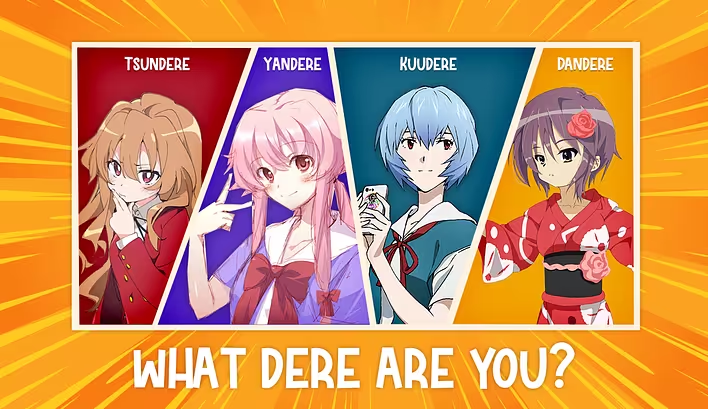
Due to the similarity with yandere, yangire is often added to large lists of “dere” types alongside tsundere, kudere, and dandere. However, the word yangire does not contain the part -dere.
In yandere, it comes from deredere and is associated with the manifestation of infatuation. In yangire, it is replaced by -gire, meaning “breakdown.”
Therefore, yangire is better viewed as a related fandom archetype that formed alongside yandere, rather than as another classic “dere” type.
Who is called yangire
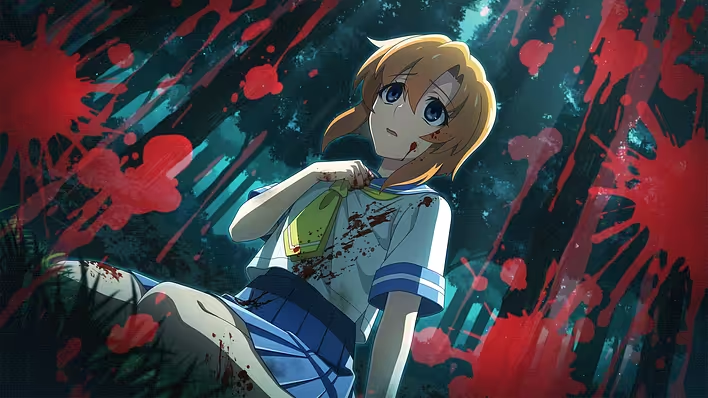
One of the most well-known examples in the Western anime fandom is Rena Ryuuguu from Higurashi no Naku Koro ni.
Rena can be cheerful and friendly, but under certain circumstances, her behavior changes sharply and becomes threatening. Moreover, the reasons for her actions are much more complex than romantic obsession, which is why the character has long been used as a convenient example to explain the difference between yandere and yangire.
But here it is important to remember one thing: such classifications are created by the fandom, not by the authors of the works. There is no official list of criteria for yangire that can unambiguously categorize all characters. The same hero may receive different definitions in different communities.
This is why lists of “yangire characters” on the internet vary so widely.
The best approach is to focus not on the presence of a knife, the number of murders, or a tragic past, but on the very core of the concept: yangire is a character with an anxious or “painful” side of personality, capable of suddenly breaking down and resorting to extreme aggression, with romantic obsession not being a necessary cause of this breakdown.
Like it?React
🧵
This post doesn't have any additions from the author yet.